
It has been a turbulent few weeks for the Green Belt in Elmbridge. While campaigners in Claygate have celebrated a significant victory, developments elsewhere are progressing despite strong local opposition. At the same time, changes to national planning rules are raising serious questions about how much influence local residents and their elected councillors still have over the future of their communities.
A welcome victory at Loseberry Farm, Claygate

Loseberry Farm, photo - Claygate Parish Council
There was good news for Claygate residents this month when The Crown Estate confirmed that it would not be proceeding with plans to develop Loseberry Farm.
The Crown Estate had been exploring options for the site, including a countryside park-led development of up to 500 homes. However, following surveys and discussions with local groups, it has now confirmed that it will not be submitting a planning application "at this time".
The announcement has been warmly welcomed by Claygate Parish Council and the Save Claygate Green Belt campaign, whose efforts helped bring attention to the importance of protecting the countryside surrounding the village.
It is an encouraging example of local communities making their voices heard. However, the wording leaves open the possibility of proposals returning in the future, so the threat has not disappeared entirely.
Elm Farm – a small development with potentially much bigger implications
Just a short distance away, another Green Belt battle is continuing at Elm Farm, off Woodstock Lane South in Claygate.
A planning application (2026/2349) seeks Permission in Principle for just six to nine homes. On the face of it, this is a relatively modest development.
However, local campaigners are concerned that it could be the first step towards a much larger scheme, potentially involving around 320 homes across the wider landholding.
Claygate Parish Council has submitted a detailed objection, arguing that the land plays an important role in preventing the outward spread of Greater London and maintaining the separation between Claygate and Chessington.
The application also raises an important question about the government's new "grey belt" policy. This allows some land within the Green Belt that makes a limited contribution to specified Green Belt purposes to be considered for development, subject to other planning tests.
The Parish Council argues that Elm Farm does not qualify as grey belt and that the location is unsuitable for housing because of its poor public transport connections and other constraints.
Critics fear that approval of a small initial development could make it easier to argue for further development later. The larger scheme is not part of the current application, but the concern illustrates how apparently minor planning decisions can have far-reaching consequences.
The application is awaiting a decision.
Clouds Hill Farm, Oxshott – a disappointing outcome
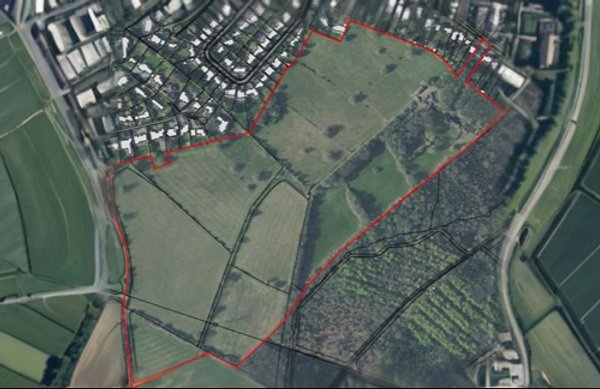
Clouds Hill Farm - photo protectoxshott.com
In Oxshott, local residents have suffered a significant setback over plans for 250 homes at Clouds Hill Farm, off Leatherhead Road.
Following the granting of planning permission, the local action group considered challenging the decision through a Judicial Review.
However, after taking advice from a specialist planning barrister, the group concluded that the prospects of success were too low to justify proceeding.
In an update published on 30 October, the Federation of Oxshott Residents' Associations (FEDORA) explained that although there were serious concerns about aspects of the planning process, the legal threshold for overturning the decision was extremely high.
Even a successful challenge might ultimately have resulted in the development being approved again.
This illustrates a fundamental problem for local communities. A planning decision can be deeply unpopular, and residents may have legitimate concerns about its consequences, without there being sufficient legal grounds to overturn it.
The residents' groups intend to continue scrutinising the detailed plans and ensuring that the developer meets its obligations.
Moore Place, Esher – a victory, but will it survive an appeal?
At Moore Place, off Portsmouth Road in Esher, councillors voted in October to refuse plans for up to 206 homes on the former golf course.
The decision was particularly significant because planning officers had recommended approval.
Councillors concluded that the development would harm the setting of historic Esher and that the site made an important contribution to the Green Belt, meaning it should not be classified as grey belt.
Under new national rules, the proposed refusal had to be referred to the Secretary of State, who decided not to call in the application. The council subsequently issued its formal refusal on 27 October.
For now, this is a welcome victory for local decision-making.
However, the developer has until 27 April 2027 to appeal to the Planning Inspectorate. If an appeal is submitted, the refusal could still be overturned.
The case demonstrates both the importance of elected councillors being able to exercise independent judgement and the uncertainty that can follow when a developer challenges their decision.
Woodstock Lane, Long Ditton – when the council cannot defend its own decision
Perhaps the most troubling recent development concerns land west of Woodstock Lane in Long Ditton.
Elmbridge Borough Council previously refused Taylor Wimpey's application for up to 144 homes. The developer appealed.
However, on 22 October, the council announced that it would not defend its refusal at the forthcoming appeal.
After obtaining independent legal and planning advice, the council concluded that changes to national planning policy and recent appeal decisions meant it had little or no realistic prospect of successfully defending the case.
Continuing could also expose local taxpayers to substantial legal costs.
The appeal will still be determined by the Planning Inspectorate, with a public inquiry scheduled for January 2027. The development has therefore not yet received permission.
Nevertheless, the situation is deeply concerning.
What is the point of a democratically elected council refusing a development if subsequent changes in national policy leave it unable to defend that decision?
Councils must, of course, act responsibly with public money. But this case illustrates how national planning policy can increasingly override local judgements about the suitability of development.
Could the housing market provide some breathing space?
There may be one factor slowing the pressure for development: the weakening housing market.
At the former Wisley Airfield, Taylor Wimpey is progressing its development of up to 1,730 homes, but there are signs of a challenging sales environment.
Properties at its Wisley Acres development have been advertised with price reductions and substantial financial incentives, including stamp duty contributions of up to £25,000 on some homes.
Although some properties have been reserved or withdrawn from marketing, publicly available information does not yet establish how many sales have been completed or whether the development is falling behind its original targets.
More broadly, Taylor Wimpey acknowledged in its 11 November trading statement that the autumn housing market had been subdued, with mortgage costs and affordability pressures affecting demand. Its private sales rate, excluding bulk transactions, fell from 0.61 to 0.54 homes per outlet per week compared with the equivalent period last year.
It remains to be seen whether this will slow the delivery of major developments such as Wisley Airfield.
A weaker housing market is hardly good news for those struggling to afford a home. However, it may provide an opportunity to reconsider the pace, location and sustainability of some proposed developments rather than simply pursuing housing numbers at any cost.
The bigger issue – is local democracy being undermined?
These individual cases come against the backdrop of fundamental changes to England's planning system.
On 31 October 2026, the government's new National Scheme of Delegation came into force under the Town and Country Planning (Discharge of Local Planning Authority Functions) (England) Regulations 2026.
The changes mean that certain categories of planning application must now be decided by professional planning officers rather than elected councillors.
For other categories, there is a presumption that officers will decide unless a nominated councillor and senior planning officer agree that the application merits consideration by a planning committee.
Importantly, the previous ability of ward councillors to require applications to be referred to committee, or for a specified number of public objections to trigger committee consideration, can no longer operate in the same way.
The government argues that these changes will make planning decisions faster and more consistent, allowing committees to concentrate on the most significant developments.
There is merit in making the planning system more efficient. But speed and efficiency should not come at the expense of democratic accountability.
Planning decisions are not simply technical exercises. They involve judgements about the character of communities, the protection of countryside, transport, infrastructure, biodiversity and the quality of life of future generations.
Professional planning officers have an essential role, but elected councillors bring local knowledge and democratic accountability that should not be undervalued.
When national policy makes it increasingly difficult for councils to refuse developments, when refusals can be overturned on appeal, and when fewer applications can be considered by elected representatives, residents are entitled to ask whether local democracy is being progressively weakened.
Protecting the Green Belt while meeting housing needs

There is no question that more homes are needed, including genuinely affordable homes for younger people and families who are increasingly priced out of Elmbridge.
But the need for housing should not mean abandoning careful planning or treating all Green Belt land as an opportunity for development.
The Green Belt has important purposes, including preventing urban sprawl, maintaining separation between settlements and safeguarding the countryside. Its protection also contributes to wider ambitions for nature recovery, climate resilience and sustainable communities.
New housing should be directed towards appropriate locations, supported by transport and public services, and designed to meet high environmental standards.
Above all, local communities must retain a meaningful voice in shaping the places where they live.
The victory at Loseberry Farm shows that community action can still make a difference. The setbacks elsewhere in Elmbridge demonstrate why that engagement is more important than ever.
The challenge now is to ensure that the drive to deliver more homes does not come at the expense of the Green Belt, sustainable development or the democratic rights of local residents.